My Accidental Journey from Designer to Occupancy Planner
I Didn’t Choose Occupancy Planning. It Chose Me.
When I was in design school, I believed there were only two paths in front of me after graduation: residential or commercial design firm. That was the way everyone talked about the profession, as if those were the only doors that existed. I imagined myself joining a commercial design firm, slowly working my way up the ladder, and one day becoming a Design Director with a design portfolio I was proud of.
I didn’t know there was an entirely different career just outside the walls of a design studio.
I graduated in 2014 from Appalachian State University, drawn to commercial design, though I couldn’t fully explain why. The turning point came during my senior capstone project. I chose to research how the office environment affects employee health, productivity, and different workstyles. The more I dug into the topic, the more I realized that workplaces are not just about finishes and furniture. They shape how people feel every day and how well they can do their jobs. That project planted a seed I didn’t recognize at the time.
If you’re still in school, I always share this advice: pick a capstone topic you genuinely care about and use it as your interview story. Mine ended up becoming the thread that connected my entire career.
The Detour I Didn’t Plan
After graduation I interned at Gensler and then joined a small A&D firm in Charlotte, NC. I loved being part of a design team, but about a year in the firm didn’t have enough work to keep me and I was laid off. At the time it felt like a door closing, but it turned out to be the best redirection.
I took a job at a furniture dealership where I prepared test fits and furniture solution packets for clients moving into new offices. The company invested in training and brought in an AutoCAD instructor who completely changed the way I used the software. For the first time, I didn’t just use CAD to complete a deadline, I actually enjoyed it. I also learned how systems furniture works in the real world, which later became one of the most practical skills I had.
Even though I liked the work, I had a growing sense that I wanted to be involved earlier in the process. I didn’t want to step in after all the big decisions were made. I wanted to be part of the conversations about how much space a company needed and what kinds of spaces would support their people best.
Then one fateful day, I received a message on LinkedIn about an opening on the Bank of America account at JLL from a complete stranger. I had never heard of occupancy planning before that message. I didn’t go looking for it, it found me.
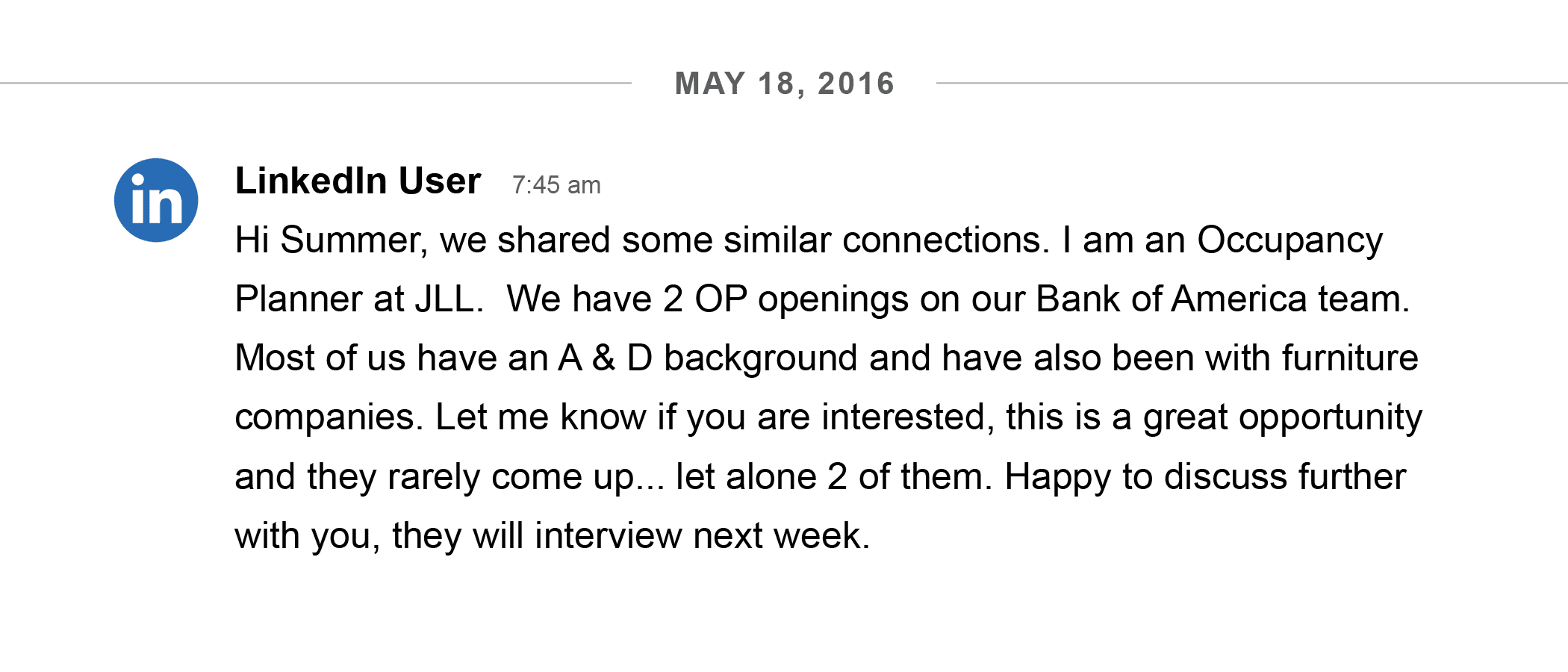
One message from a stranger introduced me to a career I didn’t know existed. This note is how I first learned about occupancy planning and eventually found my way into a role at JLL.
Learning to Speak a New Language
Design gave me a strong foundation for occupancy planning. I already knew how to space plan, create test fits, and communicate ideas visually to decision makers. Those skills translated immediately.
What didn’t translate was Excel, data analytics, and CAFM systems. I had to learn those from scratch. I approached it the same way I had approached Revit and AutoCAD, with a mix of trial and error and a lot of online tutorials. The software itself wasn’t the hardest part. Learning to think analytically and trust data was.
The biggest turning point came when I moved to California to work on the Google account. I started as an Occupancy Planner and eventually became a Senior Planner and Portfolio Strategy Manager. As my roles became more senior, the work shifted from test fits to strategy and analysis. I was finally sitting at the table before an A&D firm was ever engaged, exactly where I had hoped to be years earlier.

If you’re a design student, know this: my time at Google started with the same interior design degree you’re earning now.
Am I Still a Designer?
That question followed me for a long time.
At first I worried I was leaving design behind, but eventually I realized I was expanding what design meant. I went from designing individual spaces to designing solutions for entire organizations. Occupancy planning is still rooted in how people experience the workplace. It just uses different tools to get there.
When friends asked what I did, I usually joked that I played a never-ending game of Tetris, but with people instead of blocks.
Today I lead Occupancy Planning at Truist Financial, where I’m building an OP organization from the ground up. My focus is less about individual spaces and more about designing processes, tools, and strategies that help thousands of employees work better. In a way, it feels like the most design-focused work I’ve ever done.
What the Job Actually Looks Like
Occupancy planning changes as your career grows. Early roles are more tactical. You might be converting a meeting room into offices, negotiating space between two teams, or planning where departments will sit in a new building. The work is hands-on and closely tied to space planning.
As you advance, the role becomes more strategic. You analyze utilization data, forecast how much space a company will need, and help shape portfolios years before a project begins. There is still creativity, but it lives in problem solving and making solutions work within real constraints.
Many design students assume the data side will be overwhelming. I usually describe OP as a fifty-fifty balance between design and data. You can absolutely enter the field with a design background. The sooner you learn the data piece, the easier everything else becomes.
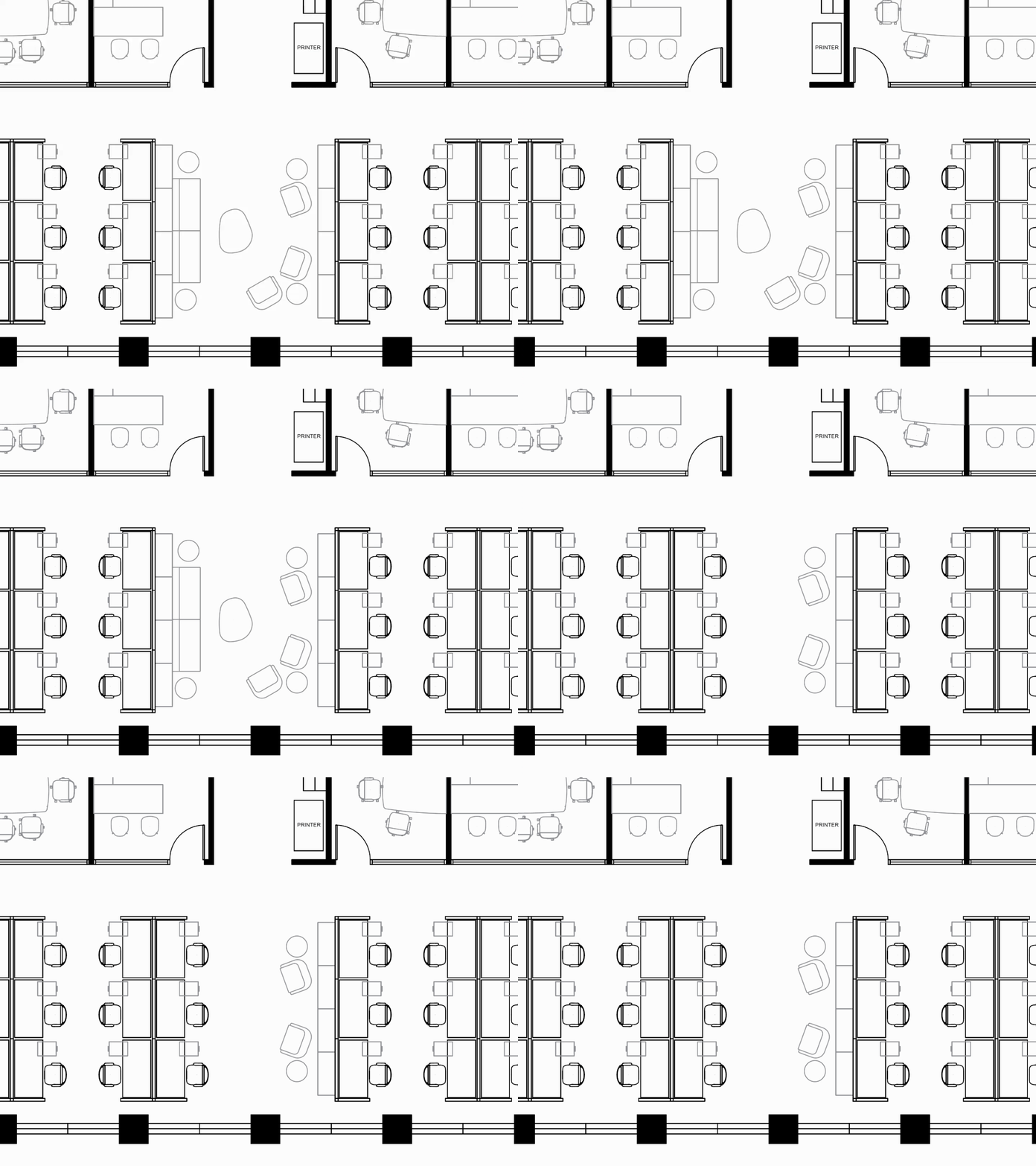
A test fit is prepared by an occupancy planner to evaluate the feasibility of adding (3) additional workstations to the floor in an open collaboration area.
The Project That Made It Click
One early project showed me exactly why this career mattered. I developed test fits for the Workplace of the Future pilot in Charlotte, applying new design guidelines that transformed rows of 8x8 cubes into a dynamic, free-address environment. It felt almost identical to my senior capstone, except this time it was real people and real change.
That project taught me that occupancy planning isn’t the step before design. It is design, just at a different altitude.
If You’re Curious About This Path
Here’s what I would tell my younger self and any student or early-career designer:
Start by looking at job postings for occupancy planning and compare the skills to what you already have. Don’t let the long list of requirements scare you. Focus on being strong in AutoCAD, space planning, test fits, and presentations. Those will carry you in the beginning.
Begin building relationships with people at commercial real estate firms like CBRE, Cushman & Wakefield, and JLL. Most of my opportunities came from who I knew, not what software I had mastered.
And if you have access to a mentoring program, sign up. I landed my role on the Google account because of mentorship from someone who had walked the path before me.
What I Hope You Take Away
Your design degree is a foundation, not a cage.
Data skills are a multiplier, not a barrier.
The workplace needs designers who understand both people and numbers.
I never planned to become an occupancy planner. I followed curiosity, survived a layoff, learned Excel, and said yes to a LinkedIn message from a stranger. If you’re wondering what else exists beyond the design studio, consider this your permission to explore the door you didn’t know was there.